The essential documents and where to get them
For many first-time international travelers, the list of documents you need to have in order to fly overseas can be confusing because it all depends on where you are a citizen. For the sake of providing the most accurate knowledge, this post will be specific to the United States as that is where I am from and what I know the most about.
With each of these documents, I highly suggest that you make several color copies and leave one or two of those copies with trusted family or friends and bring another copy with you as a backup copy to the original document. I usually leave the copies in the hotel safe and bring the original out and about with me, or vice versa. Either is fine as long as you don’t carry both the copies and originals at the same time.
The Basic Necessities:
These are documents you absolutely must have (as long as it pertains to your situation and where you are traveling) and it is essential that you check the expiration dates of these documents well in advance. If you don’t already have any of them, I’d suggest getting the process started well in advance, as well. I personally recommend at least six months before your departure date to give yourself plenty of extra time if anything gets delayed. However, it’s best that you double check requirements for specific things like visas because for certain places, that process may take even longer; I’ll explain more below. To skip ahead to any sections, just click on the links below.
- Passport
- Visas
- Medication prescriptions
- Consent for traveling with minors
- International driving permit
Passport
There are a few things to know about US passports. First, if you are traveling outside of the United States via airplane (even to Canada and Mexico) then you need a passport book. For initial applicants, it’s important to note that you need to apply for a passport book which is different than a passport card. You can view the requirements and differences here.
The second thing to know is that for children under the age of 16, passports are valid for five years and there are specific requirements for obtaining it. You can view those here. For children between the ages of 16 and 17, passports requirements can be found here. For those who are applying for or renewing a passport over the age of 16, your passport will be valid for ten years.
Note that the processes for first time applicants are similar to those renewing their passports, and the specific requirements for first time applicants can be found here.
The third and final thing to know is that many countries require that your passport expiration date will be at least six months after the date of your departure from said country. This confuses many first time applicants and international travelers because the verbiage on the US government website is confusing. Here is a very clear example: if you are traveling from the United States to an international destination, and your flight back home to the United States is on May 20, 2028, then your passport should have an expiration date of November 20, 2028 or later, which is six months after your flight back home. I have seen some European countries stating it’s only a three month requirement but to err on the side of caution, I would ensure it’s six months. With all that said, every country is different and it’s best to look up the requirements for the individual countries you will be visiting to make sure your passport will be valid there.
Visas
While having a US passport does allow entry to many countries without the need for a visa, there are still many places that American travelers cannot visit without a visa. Unfortunately, the requirements for needing a visa and the process for obtaining one differ from country to country so I cannot give much detail for how to get one.
What I can say is that US passport holders do not need a visa for tourist-related travels to Canada, Mexico, and almost all of Europe (but make sure to note the information regarding visits to the Schengen area in the next paragraph). It’s best and also important to check with the individual countries you are visiting to confirm whether or not you need one and if so, what kind of visa and how to get one.
For US passport holders traveling to European countries within the Schengen area, it’s important to note that you may only stay in the Schengen area for up to 90 days in a 180-day period. After those 90 days are up, you are required to wait an additional 90 days before re-entering any country within the Schengen area.
It’s also important to note that while this process has not yet started and has been pushed back a number of times, US passport holders will eventually be required to obtain an ETIAS travel authorization before traveling to Europe. Many people have been confused and concerned about the process but I assure you, it’s going to be a simple process. You will need the items listed below as well as a credit card to pay the €7 fee upon submission.
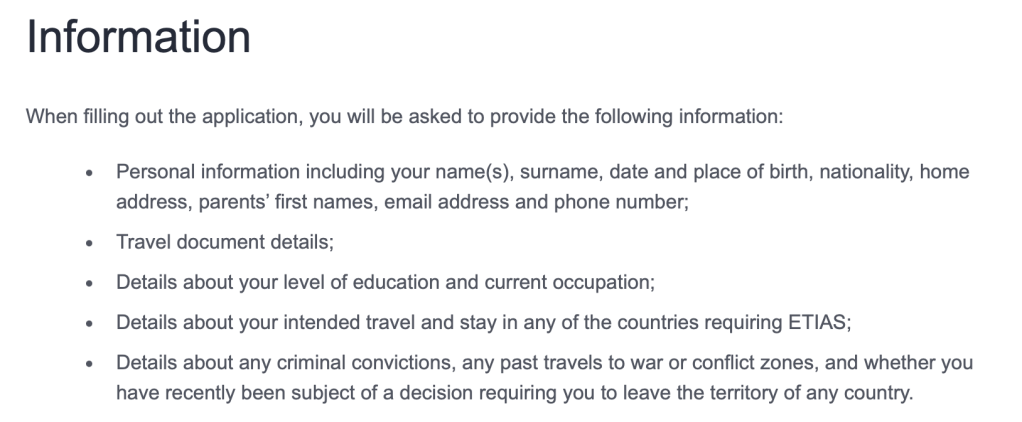
As of now, the ETIAS authorization is not expected to start until late 2026 but as I said, it has been pushed back several times already so that is not a concrete date. I will update this post as more information becomes available.
Medication prescriptions
There are some medications that are more heavily regulated, and even illegal, in other countries than they are in the United States. This includes both prescription medication and some over-the-counter ones as well. If you take prescription medication, it’s best to check with the embassy of your destination to see what documentation you may need to bring to prove that you are legally allowed to have that medication with you. The same goes for OTC medications. If you will be bringing things like Tylenol or Aleve, it’s best to check with your destinations embassy regarding requirements for what kind, how much, etc.
Consent for traveling with minors
If you are traveling alone with children, many foreign countries will require either notarized written consent from the children’s other parent or custody documentation proving that you are the sole voice of consent. As with visas and medications, it’s best to check with your destinations embassy to confirm if you need to provide documentation and what that documentation needs to say.
International driving permit
If you are planning to rent a car while traveling internationally, you should know that many countries will not recognize a United States drivers license but they will accept an international driving permit. While this only applies if you are going to be renting a car and driving it, I’d recommend that all passengers get one as well if there’s even the slightest chance that they will be driving.
Many people will tell you that they have been able to rent a car in foreign countries without having an IDP. However, the most important thing to know here is that while the car rental company may not ask for or even require one, if you get pulled over, the police will absolutely require one so it’s essential to get an international driving permit.
You can get an IDP in person at your local AAA office or by mailing in an application and paying $20. The specifics for the application process can be found here. Your IDP may not be issued more than six months before your desired effective dates. So, if you are traveling in June, your IDP may not be issued any earlier than January of that year.
Recommended, but not required:
These things are highly recommended as they can be useful in various situations but they are not required. Personally, I’d recommend each of these things as they can never hurt.
Travel insurance
I swear by travel insurance. I don’t mean the insurance that your airline offers to you with the purchase of your ticket, though that is useful too. I mean purchasing a travel insurance policy specific to you, your travel dates and location, and how much you want to be covered for in the case of theft, prolonged illness, delayed transportation, natural disasters, and more.
Being in a foreign country where you need to find a hospital or report a theft to the police can be stressful, especially if you don’t speak their native language. Having travel insurance won’t take away from the fact that you’ll still need to find a hospital or report to the police, but it will help with the monetary coverage and resolutions for those situations.
It’s best to shop around for travel insurance that fits your individual needs and make sure to read the fine print in each of the insurance policies you are considering. There are often different levels of coverage to each insurance policy as well, depending on how much you want to have covered. Of course, the more you want covered, the more the insurance premium will be. So take your time, shop around, do some research, and choose the best policy for you.
Smart Traveler Enrollment Program (STEP)
The Smart Traveler Enrollment Program, or STEP, is a free, online resource specifically for US citizens that provides travel and safety updates about your destination and also helps the US Embassy and family members contact you in case of an emergency. You can sign up for free here and it will ask you to enter your contact information along with your destinations, addresses and phone numbers of your accommodations (if desired) and dates of travel.
The mobile app is free to download from the App Store and GooglePlay and shows where the US Embassy and Consulates are in each country as well as how to contact them during daytime hours and in the case of an emergency. It also explains entry, exit and visa requirements for each country so it can be a great source of information for that, as well.
Credit cards and banks
The final recommendation I have is to contact your credit card companies and banks anywhere from two weeks to a few days before your trip to notify them of your travel dates and destinations. There is nothing worse than getting to a foreign country and trying to buy something but having your credit card get declined. Then you have to contact the credit card company or the bank and that leads into making international calls, and depending on your phone plan and what kind of cellular service you’ve elected to have overseas, it can get very complicated.
It’s best to notify your credit card companies and banks that you will be traveling so they don’t flag your purchases as fraudulent activity. It’s also important to tell them because in case your card gets lost or stolen, they should be able to overnight a new card to you since they are aware you are overseas.
Nowadays, many banking and credit card apps allow you to create travel notifications on the app without needing to call anyone. If you can’t find a place to do it online, then just call the customer service number and they’ll help you out.
Hopefully I’ve provided you with helpful information about what essential documents you need and how to get them. If all else fails, you can simply Google it but just be cautious of any websites trying to sell you passports or other travel documents that aren’t the official government websites.
The world is waiting for you so go embrace your wanderlust!

 Embrace Your Wanderlust
Leave a reply to Packing essentials & how to pack carry-on only – Embrace Your Wanderlust Cancel reply